Ask most engineering managers where their teams lose the most time, and "waiting for code review" comes up before almost anything else. A pull request gets opened, and then it sits. It sits while a reviewer finishes their current task. It sits through lunch. It sits overnight because the reviewer is in a different timezone. By the time it gets looked at, the author has mentally moved on to something else, and context-switching back costs another 20 minutes. Multiply that across every engineer and every sprint, and the compounding cost becomes staggering.
This isn't a people problem. Engineers want to ship. They want their work reviewed and merged. The problem is structural: code review is treated as a reactive, interrupt-driven activity rather than a first-class workflow with defined expectations, tooling, and feedback loops. The good news is that it's a solvable problem. Teams that invest in the right combination of process changes and tooling consistently cut their PR cycle times in half, sometimes more. This guide covers the six most effective techniques, grounded in DORA research and what engineering teams are actually doing in 2026.
Why PR review time matters more than you think
The DORA (DevOps Research and Assessment) research program has tracked engineering performance at thousands of organizations for over a decade. Their findings are unambiguous: the highest-performing engineering teams share a consistent set of behaviors, and lead time for changes (the time from a code commit to that code running in production) is one of the four core metrics that separates elite teams from the rest.
PR review wait time is typically the largest variable component of lead time. It's not build time. It's not deploy time. It's the time a change spends waiting for a human to look at it. According to DORA's 2023 State of DevOps report, elite performers deploy multiple times per day and have lead times measured in hours (under one day). High performers achieve lead times of one day to one week. Medium performers measure in one week to one month, and low performers can wait one to six months between commit and production. The difference between elite and medium performance often comes down entirely to how long PRs sit in review queues.
Beyond DORA metrics, research from the SmartBear State of Code Review study found that reviewers who spend more than 60 minutes on a single review catch significantly fewer defects per hour than those reviewing in shorter sessions. Optimal review length is 200–400 lines over 60 minutes or less. Above that threshold, defect detection rates fall sharply, which means large PRs don't just take longer to review; they produce worse reviews.
There is also a real psychological cost that is harder to quantify. Software development is deeply context-dependent. When an engineer opens a PR, they have a complete mental model of the problem they solved: the edge cases they considered, the tradeoffs they made, the follow-up work they deferred. Every hour that passes before they get feedback is an hour in which that mental model begins to decay. When a reviewer finally responds 18 hours later with a question or a requested change, the author has to reconstruct context they have long since set aside. That reconstruction cost is real, and it compounds across every iteration of the review.
The teams that take PR review time seriously treat it the same way they treat build performance: as an engineering infrastructure problem worth investing in, not a human behavior problem to complain about.
The 6 most effective ways to reduce PR review time
1. Automate the first pass with AI code review
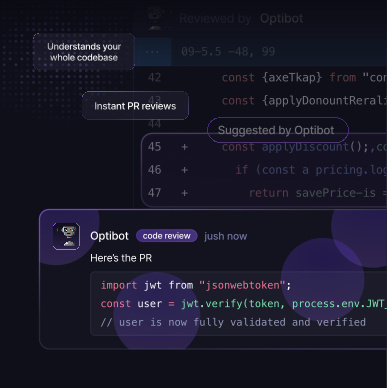
The single highest-leverage change most teams can make is putting an AI code reviewer in the loop. The first review pass (the initial read-through that catches style issues, obvious logic errors, missing error handling, and potential security vulnerabilities) is exactly the kind of pattern-matched, repeatable work that AI handles well. And it can happen within minutes of a PR being opened, rather than hours.
Here's what this changes practically: instead of a PR sitting in a queue waiting for a human's attention, it gets an initial round of inline comments almost immediately. When a human reviewer does sit down to look at it, they're not staring at a blank diff. They're reviewing a pre-annotated document. The obvious issues are already surfaced. The reviewer can skip past the boilerplate and focus their judgment on the things that actually require it: the architectural decisions, the business logic correctness, the long-term maintainability tradeoffs.
Optibot is purpose-built for this. It connects to your GitHub or GitLab repositories and posts inline review comments on every pull request within minutes of opening, before any human reviewer has looked at it. Reviews cover logic bugs, security vulnerabilities, code style, test coverage, and cross-file dependency issues that require understanding your full codebase, not just the changed lines. Teams that add Optibot to their workflow typically see their time-to-first-review drop from hours to minutes, because the AI review is already there.
2. Keep PRs small and focused
There is a near-universal finding in software engineering research: smaller pull requests get reviewed faster, get more thorough reviews, and get merged with fewer defects. The 400-line heuristic (keeping PRs under 400 lines of changed code) exists for good reason. Above that threshold, reviewers begin to suffer from cognitive overload, miss issues they'd catch in a smaller PR, and unconsciously deprioritize the review because it feels like a big commitment of time.
The psychology is straightforward. A 200-line PR feels like a 20-minute task. A 1,200-line PR feels like it needs a dedicated hour block, which gets pushed to "later." "Later" becomes tomorrow. Tomorrow becomes next week. The PR sits.
Keeping PRs small is a discipline. It requires breaking features into smaller logical units, submitting draft PRs for in-progress work that needs early feedback, and sometimes asking engineers to split a refactor from a feature addition. Teams that enforce this consistently see review time drop not because reviewers are faster, but because reviews are less daunting to start. A good rule of thumb: if a PR touches more than three unrelated files, it should probably be two PRs.
3. Set clear review SLAs and expectations
Most engineering teams have no explicit expectation for how quickly a PR should receive its first review. "When you have time" is the de facto policy, which means review happens whenever the interruption happens to land at a convenient moment (which is often never, or not for a long time).
High-performing teams treat first-review time as a commitment. A common norm is that any PR opened before noon gets a first review by end of day; any PR opened after noon gets a first review by noon the next business day. Some teams are more aggressive: four business hours as a default SLA. The specific number matters less than having a number at all.
Alongside the SLA, define clearly who reviews what. Ambiguity about ownership is a major driver of review delays. If it's everyone's job to review a PR, it becomes no one's immediate priority. Rotating reviewer assignments, required-reviewer rules, or code ownership files (like GitHub's CODEOWNERS) help ensure that PRs land in a specific person's queue rather than floating in a shared pool.
4. Use engineering analytics to find bottlenecks
You can't improve what you can't see. Most teams have a vague sense that PR reviews are slow, but no precise data on where the time goes. Is the problem that PRs wait too long for a first review? That reviews have too many back-and-forth iterations? That a specific author's PRs consistently have longer review times? That one reviewer is a bottleneck because every senior PR requires their sign-off?
Engineering analytics dashboards answer these questions with data. Tracking PR cycle time (open to merge), time to first review, and review iterations per PR (broken down by author, reviewer, and codebase area) reveals the specific patterns worth addressing. Sometimes the bottleneck is obvious once you have the data: one senior engineer reviews 60% of all PRs, and their review queue is the constraint. Sometimes it's less obvious: PRs that touch a specific service consistently take twice as long to review because nobody on the team has deep context there, which is itself actionable information.
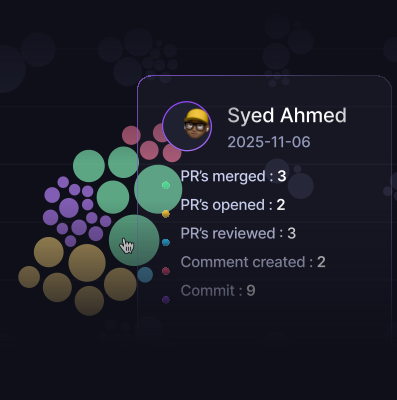
Optibot's engineering analytics dashboard tracks PR cycle time, time-to-first-review distributions, reviewer load, contributor velocity, and DORA metrics natively, in the same platform as your code reviews. You don't need a separate analytics tool to understand why your reviews are slow. The data is already there, alongside the reviews themselves.
5. Write better PR descriptions
A reviewer who opens a PR and has no idea what it's trying to accomplish has to spend the first several minutes just orienting themselves. What problem does this solve? What was the previous behavior? What changed and why? What edge cases were considered? Without context, reviewers read code defensively. They have to reverse-engineer intent from implementation, which takes much longer and produces worse reviews.
A well-written PR description is an investment that pays off immediately in faster review time. At minimum, a PR description should cover: what this change does in one sentence, why it was needed, what the key decisions were (and what alternatives were considered), and what to test. Many teams implement PR description templates, a lightweight markdown file at .github/pull_request_template.md that surfaces these prompts automatically when a PR is created.
Teams that adopt PR templates consistently report that reviews complete faster and with fewer clarifying questions. The time saved in review more than compensates for the extra two minutes the author spends writing the description. It also creates a useful artifact for future reference: when someone is debugging a production issue six months later, a well-documented PR is far more useful than "fix some stuff."
6. Reduce back-and-forth with async communication norms
Many review cycles are slower than they need to be not because reviewers are slow to respond, but because of unnecessary synchronous friction. A reviewer leaves a comment. The author responds. The reviewer doesn't see it until the next day. One clarifying question stretches a review across three calendar days.
Async-first review norms compress this. The most effective pattern is for reviewers to batch all their comments in a single round rather than posting them one at a time as they come up. This prevents the author from responding to early comments before the reviewer has finished reading, which creates unnecessary back-and-forth. Similarly, authors should respond to all comments at once rather than individually, making it easy for the reviewer to do a single final pass.
Teams should also distinguish between "blocking" and "non-blocking" comments explicitly. A nit about variable naming should never block a merge the same way a logic error does. Using conventions like "nit:", "suggestion:", and "blocking:" in comment prefixes lets authors triage reviewer feedback quickly and keeps minor stylistic feedback from becoming a hold on forward progress.
How automated first-pass review reduces wait time
It's worth being specific about the mechanism by which automated review reduces PR wait time, because there are two distinct effects that work differently and compound.
The first effect is eliminating the cold start problem. In a traditional workflow, a PR sits in a queue until a human reviewer picks it up. There is no partial review, no preliminary feedback, just silence until someone has time. An automated first-pass reviewer eliminates this cold start entirely. Within minutes of a PR being opened, the author already has a first round of feedback to work with. If there are obvious issues (a missing await, a SQL injection vector, an unhandled edge case) the author can fix them immediately, before any human reviewer has even seen the PR. By the time a human reviewer does look, those issues are already resolved. The human reviewer's time is spent on things automation can't catch: judgment calls, architectural concerns, whether the approach makes sense given the team's longer-term roadmap.
The second effect is reducing review iterations. Many PR review cycles have two, three, or four rounds of back-and-forth because the author submits work that has preventable issues. Not intentional tradeoffs, but things like inconsistent error handling, missing test coverage for an edge case, or a security issue introduced inadvertently. Each round of feedback is another wait cycle. Automated first-pass review catches a significant fraction of these issues before the first human review, compressing a three-round review into a one-round review.
In practice, this workflow looks like: a developer opens a PR. Within a few minutes, an AI reviewer (such as Optibot) has posted inline comments on the diff: a specific line-level note about an async issue, a flag on a potential SQL injection, a suggestion for a missing null check. The developer addresses those comments, pushes a fix, and then requests review from a human colleague. When the colleague opens the PR, they arrive to a diff that has already had one cleanup pass, with the AI's resolved comments as a record of what was caught and fixed. They can focus immediately on the things that require their specific knowledge and judgment.
The approach generalizes beyond any single tool. Whether your team uses an AI reviewer, a linter suite with automated PR comments, or a combination of static analysis tools wired to post feedback on open PRs, the goal is the same: no PR should ever be waiting for its very first signal of feedback.
The financial cost of waiting
If each PR waits an average of 4 hours for its first review, and a team ships 10 PRs per week, that's 40 engineer-hours per week spent in a blocked state: not doing anything, just waiting. Over a 50-week year, that's 2,000 blocked engineer-hours. At a fully-loaded engineering cost of $150/hour, that's $300,000 per year in pure wait time for a single team. Most teams have far more than 10 PRs per week. The math compounds fast.
The hidden quality and morale cost
The financial cost is only part of the picture. Research on developer context switching finds that it takes an average of 23 minutes to fully regain focus after an interruption. A PR that waits 18 hours for review forces the author to context-switch back into a problem they've mentally closed. Multiply that by 3–4 review iterations and the cognitive overhead rivals the original development time. Slow review cycles also erode code quality: reviewers who are behind on a queue rush their reviews, missing bugs they would have caught if they weren't under pressure. Fast review pipelines produce both faster shipping and better code.
See your team's PR cycle time. Optibot's analytics dashboard surfaces cycle time trends, reviewer bottlenecks, and contributor velocity, alongside AI-powered code reviews on every PR.
Measuring the impact: what to track
Improving PR review time is only meaningful if you're measuring it. These are the metrics that give you a complete picture of your review pipeline health and the specific thresholds that distinguish high-performing teams from average ones.
PR cycle time (time to merge) is your headline metric: total elapsed time from PR open to PR merged. It captures everything (review wait time, review iterations, and any approval or CI delays). This is the metric most directly correlated with DORA's Lead Time for Changes.
Time to first review is the most actionable sub-metric. It tells you how long PRs wait before any human has looked at them, which is often the single largest component of total cycle time and the most improvable with process changes.
Review iterations per PR measures how many rounds of feedback a PR goes through before it's approved. A high iteration count suggests either that PRs are being submitted before they're ready, that expectations aren't clearly communicated, or that the review process has unhealthy back-and-forth patterns. Automated first-pass review tends to reduce this number directly.
| Metric | Good | Needs Improvement | Critical |
|---|---|---|---|
| PR cycle time | Under 8 hours | 8–24 hours | Over 24 hours |
| Time to first review | Under 2 hours | 2–8 hours | Over 8 hours |
| Review iterations per PR | 1–2 rounds | 2–4 rounds | 5+ rounds |
These thresholds are informed by DORA research and the benchmarks we see across engineering teams using Optibot's analytics. "Good" corresponds to what DORA classifies as high or elite performance; "Critical" corresponds to patterns we see in teams experiencing significant delivery friction. Most teams land somewhere in the "Needs Improvement" band when they first start measuring, which is actually good news, because it means the improvement potential is large and achievable.
"The goal isn't zero review time. It's making sure review time is spent on decisions that require human judgment. Every minute a human reviewer spends catching a null pointer issue or a style violation is a minute not spent on architecture, correctness, and design. Automating the first pass doesn't reduce review quality. It increases it."
Common mistakes that slow down PR reviews
Most of these are recognizable patterns. Each one has a specific fix.
- PRs that try to do too much. A PR that refactors a module, adds a new feature, and fixes three unrelated bugs will take forever to review and will be reviewed poorly. Split the work. Ship smaller chunks more often. A practical rule: if you can't summarize what the PR does in one sentence without using "and," it should be split.
- No clear description of what changed or why. Reviewers who have to deduce intent from code take longer and produce shallower reviews. Two minutes of description saves thirty minutes of review friction. Add a
.github/pull_request_template.mdto your repo and teams will naturally write better descriptions without being nagged. - Assigning review to "everyone" or the whole team. Diffused responsibility produces diffused action. Assign specific reviewers. Use CODEOWNERS. Make review a named person's job, not a floating team obligation. If no one is assigned, the PR should not be considered "waiting for review" on any metrics dashboard.
- No SLA or expectation for first response. "When you have time" means whenever the reviewer happens to be free, which is often later than you'd like. Set a concrete target (4 business hours is widely achievable) and make it visible. Track it in your engineering analytics so teams can see whether they're meeting it.
- Posting review comments one at a time as they come up. This creates unnecessary reply-wait cycles. Reviewers should read the whole PR, then post all comments in one batch. Authors should respond to all comments at once. Both sides of this habit can be established with a single team agreement documented in your engineering handbook.
- Not distinguishing nits from blockers. If every comment carries the same weight, every review takes longer than it needs to. Prefix comments with "nit:", "suggestion:", or "blocking:" so authors can prioritize, and merge isn't held up by minor stylistic disagreements.
- Skipping AI first-pass review. In 2026, running PRs through an AI reviewer before requesting human review is table stakes for teams serious about velocity. There's no good reason to send a human reviewer into a PR that has avoidable issues waiting to be found.
Conclusion: tooling and culture, together
Reducing PR review time is not a single-lever problem. The teams that achieve the most dramatic improvements (cutting cycle times from 24 hours to 6 hours, from 6 hours to 2 hours) do it through a combination of tooling and cultural norms that reinforce each other.
The cultural changes (small PRs, explicit SLAs, clear reviewer assignments, good descriptions, async communication norms) address the human dynamics that make review slow. These changes are free to implement and pay dividends immediately. But they have limits: even a team with perfect review culture will see cycle times constrained by the first-pass problem, the time a PR spends waiting for any feedback at all.
The tooling changes (automated first-pass review, engineering analytics dashboards) address the structural constraints that culture alone can't solve. Automated review eliminates the cold start problem and reduces review iterations. Analytics make the bottlenecks visible so teams can address the right problems rather than guessing.
The most effective teams combine both. If you're starting from a place where PRs routinely wait 18–24 hours for review, here is the highest-leverage sequence to follow: 1. Set review SLAs and make them visible, since this changes behavior immediately at zero cost. 2. Enforce small PR size, since this is the single biggest structural driver of fast reviews. 3. Add automated first-pass review, since this eliminates the cold start problem and gives human reviewers a running start. Layer in PR templates, async norms, and engineering analytics as you go. Most teams that follow this sequence see measurable cycle time improvements within a single sprint.
For automated first-pass review and the engineering analytics to measure whether it's working, Optibot is built specifically for this. It is the only AI code review tool that combines full codebase context (not diff-only), built-in cycle time and DORA metrics, and flat $29/user/month pricing in a single product. Most teams connect it to their GitHub or GitLab repository and have their first automated reviews running within five minutes. Start a free trial to see your team's PR cycle time data and what Optibot catches on your actual codebase.
The goal is an engineering workflow where code review is a fast, low-friction feedback loop, not a bottleneck that engineers dread and managers chase. That workflow is achievable. The teams doing it aren't special. They've just invested in making the process work.